No. 3 ·

The room around the music

Title pages, instrument changes you can hear, a waltz that started in 4/4, the small marks that make a page easy to read, and warmer colours.
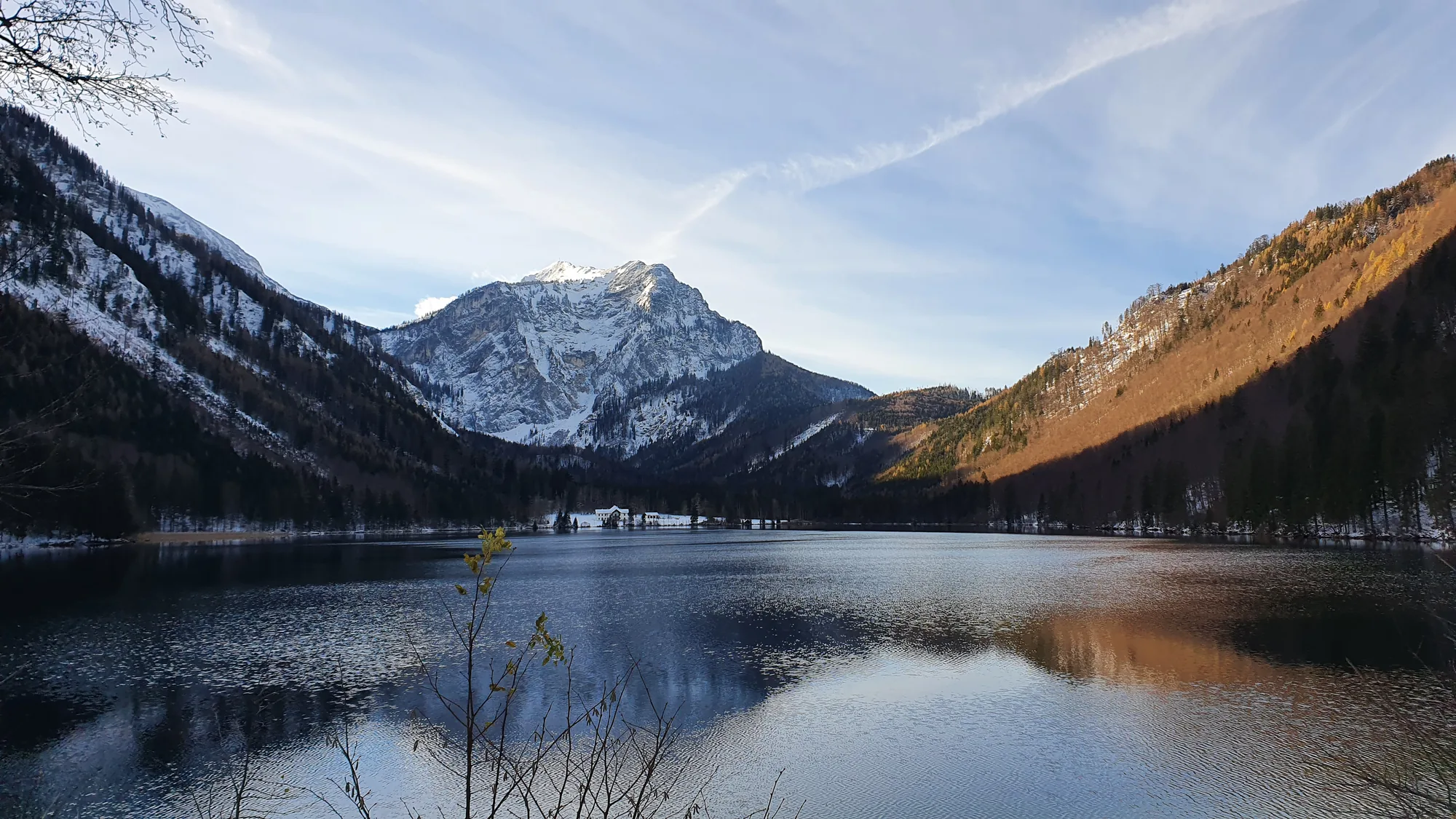
A lake in the Salzkammergut in the late afternoon: snow on the peaks, the slopes in autumn colour, the water still.

Last week I said I was working on the titles and the title page. That is mostly done now, and a few other things came along with it. Everything in the pictures was engraved by Arietto, with nothing moved by hand.
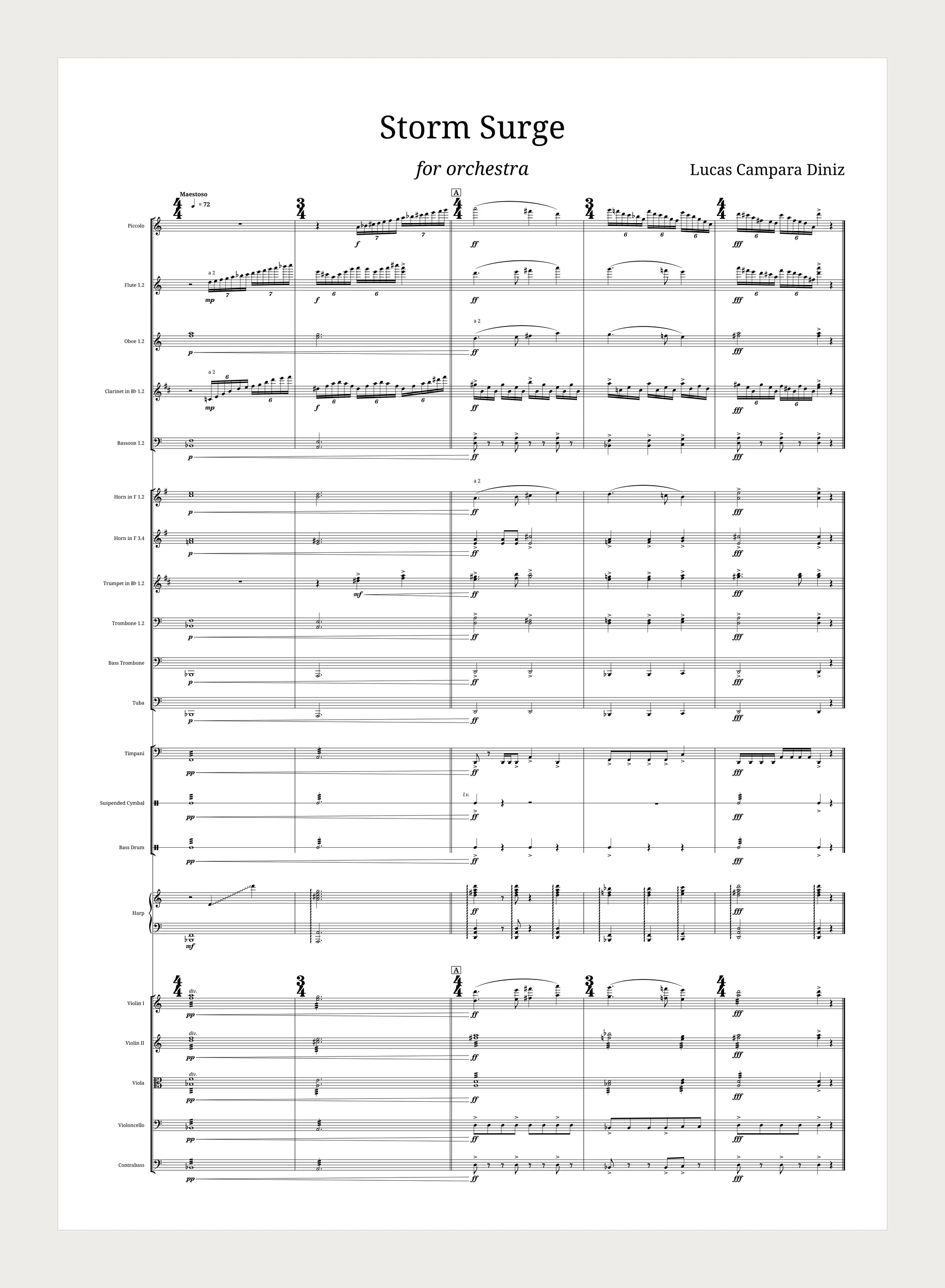
A full page of Storm Surge, for orchestra: woodwind runs, brass chords with accents, timpani and cymbal rolls, a harp glissando and the strings in tremolo, with large time signatures above the score and above the strings.

The title page

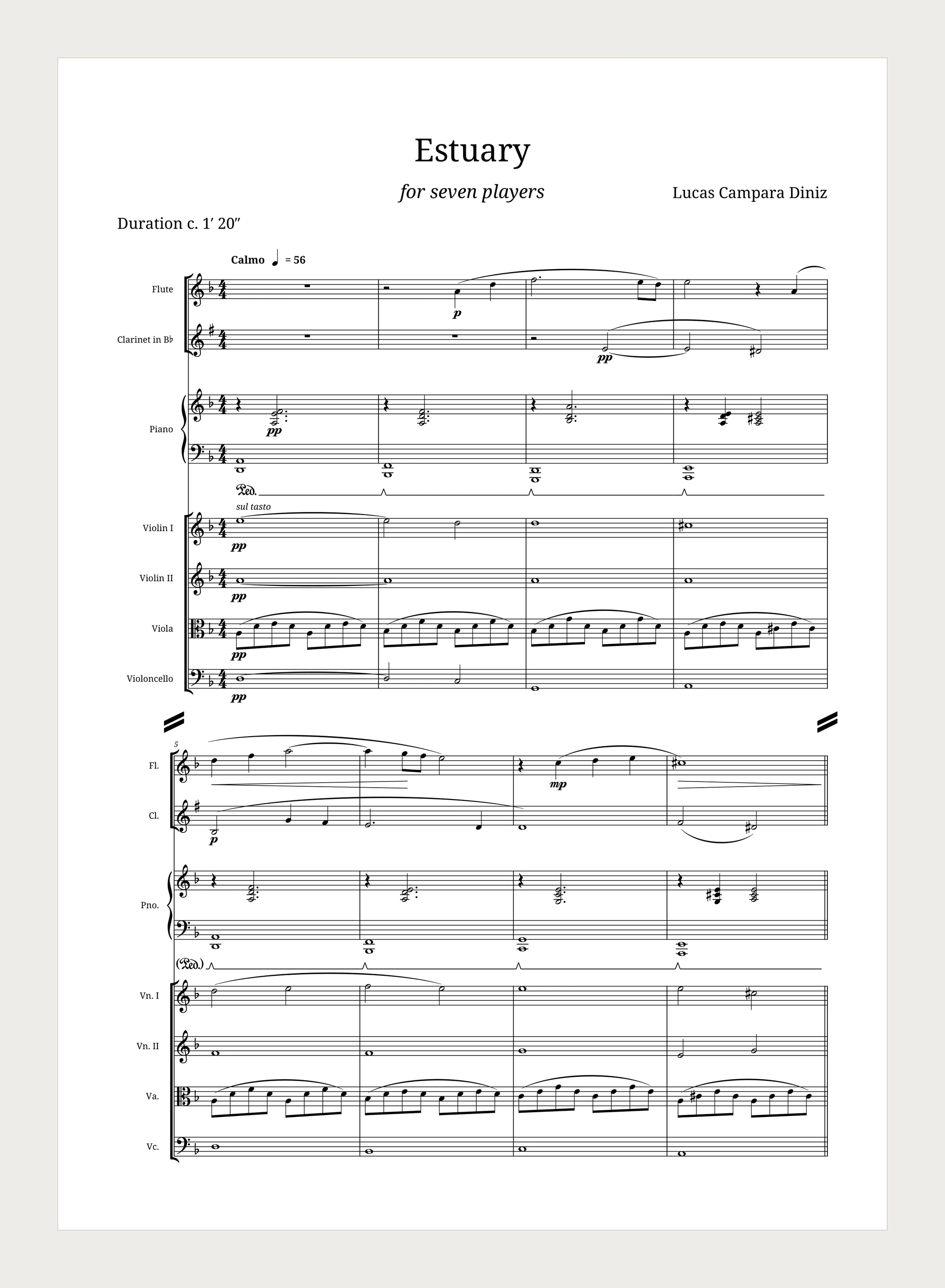
The first page of Estuary, for seven players, as it prints: the title, the subtitle "for seven players" in italic under it, the composer on the right at the height of the subtitle, a line "Duration c. 1′ 20″" on the left above the first system, and two systems of music for flute, clarinet in B flat, piano, two violins, viola and cello, with the divider mark, two short slanted strokes, at both ends of the space between them.

A score is more than its notes. There is the title and the subtitle, the composer, maybe a lyricist or an arranger, an opus number, a dedication, a copyright line, and on every later page a header and a page number. In Arietto you type each of these once, and you can type them right on the page, where they will print.

You can add lines of your own too, like the duration line above. Each line can be bigger or smaller, bold or italic, on the left, in the middle or on the right, and you can drag it exactly where you want it. While you drag, Arietto shows you what it lines up with.

Changing instruments
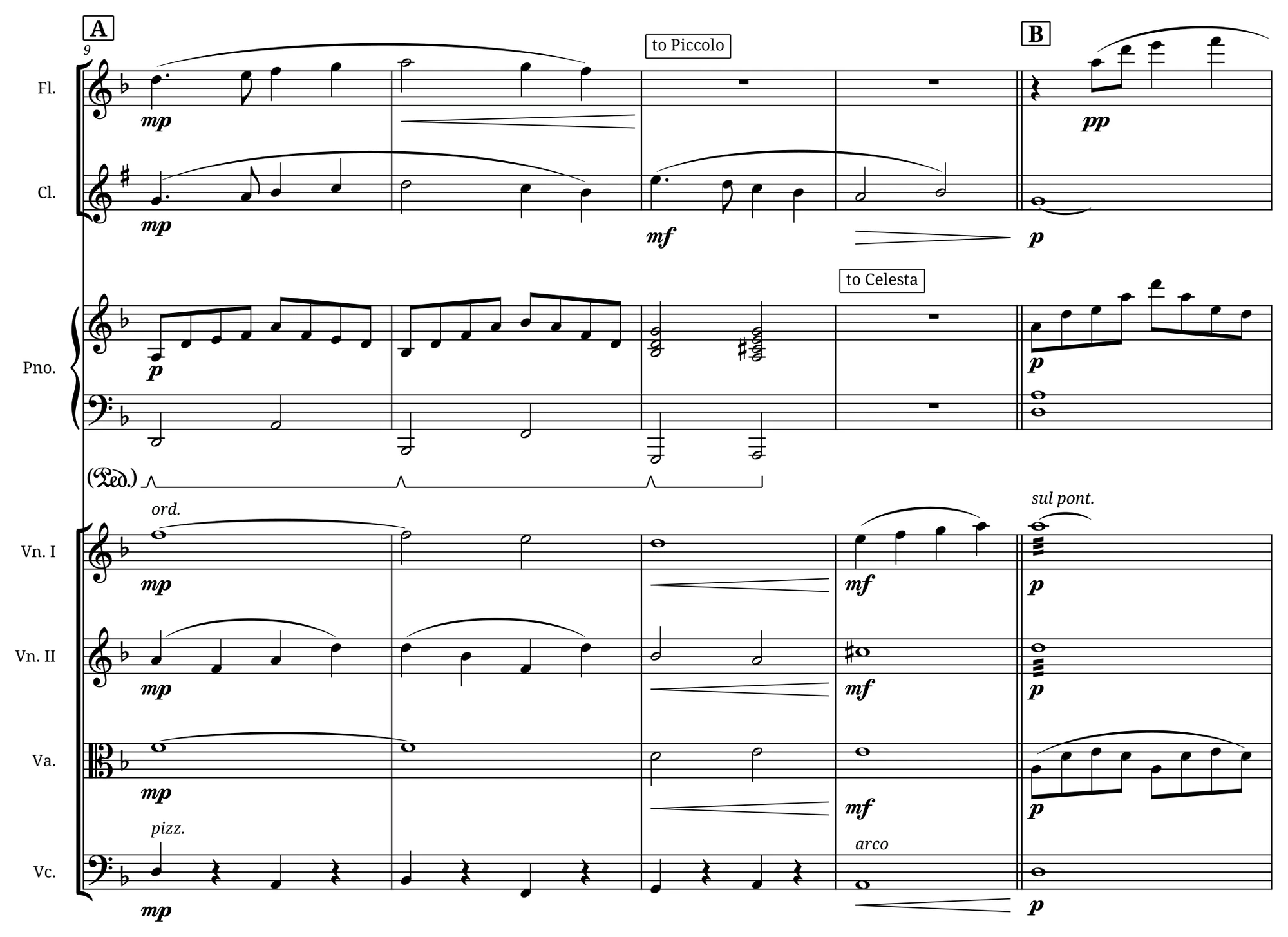
Bars 9 to 13 of Estuary, for flute, clarinet in B flat, piano, two violins, viola and cello. The flute's phrase ends in bar 10 and "to Piccolo" stands boxed over its rest in bar 11; the piano's last chords are in bar 11 and "to Celesta" stands boxed over its rest in bar 12, above the upper staff only. At rehearsal letter B the piccolo and the celesta come in together, over tremolo in the violins, a viola figure in eighths and a held note in the cello.

When a flute player has to switch to piccolo, they need to know in time, and they need a rest to do it. Arietto puts "to Piccolo" in the first rest after the flute's last note, so the whole rest is there for the change. A pianist moving to the celesta gets the note once, above the right hand, not on both staves. And playback follows: from the change on, you hear the piccolo and the celesta.

When it turns out to be a waltz
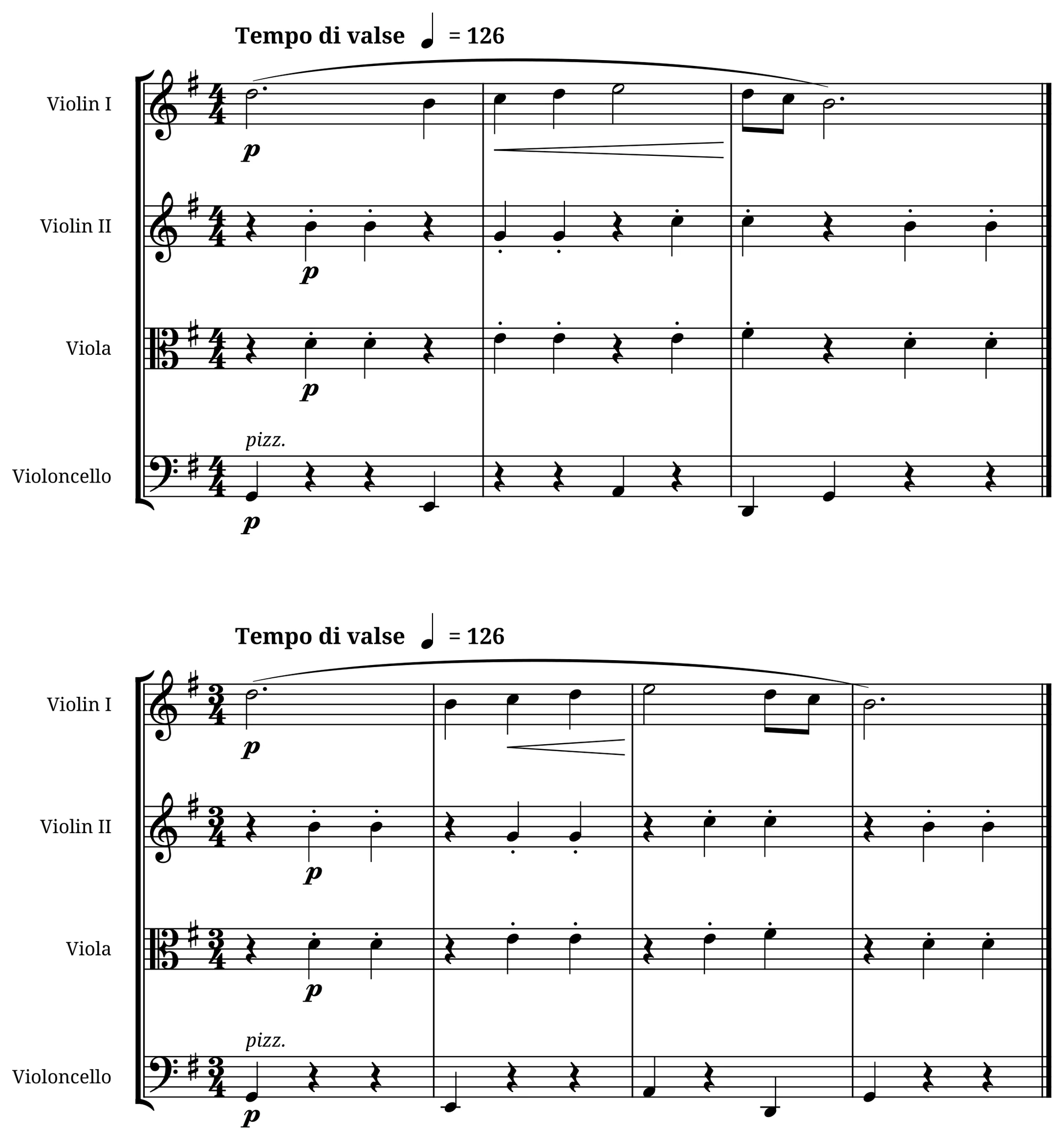
The four bars of Slack Water, a slow waltz for string quartet, shown twice. Above, as typed in 4/4: three bars in which the waltz's pattern, a bass note and two chords, no longer lines up with the barlines. Below, after 3/4 was written over it: four bars of waltz, each with the cello's pizzicato on the first beat and the chords of the second violin and the viola on the second and third.

Sometimes you start in 4/4 and the music turns out to be a waltz. Write 3/4 over it, and Arietto asks what to do: move the notes into bars of the new length, squeeze them to fit, cut what doesn't fit, or leave everything as it is. The waltz above went from 4/4 to 3/4 with one answer.

Contemporary techniques
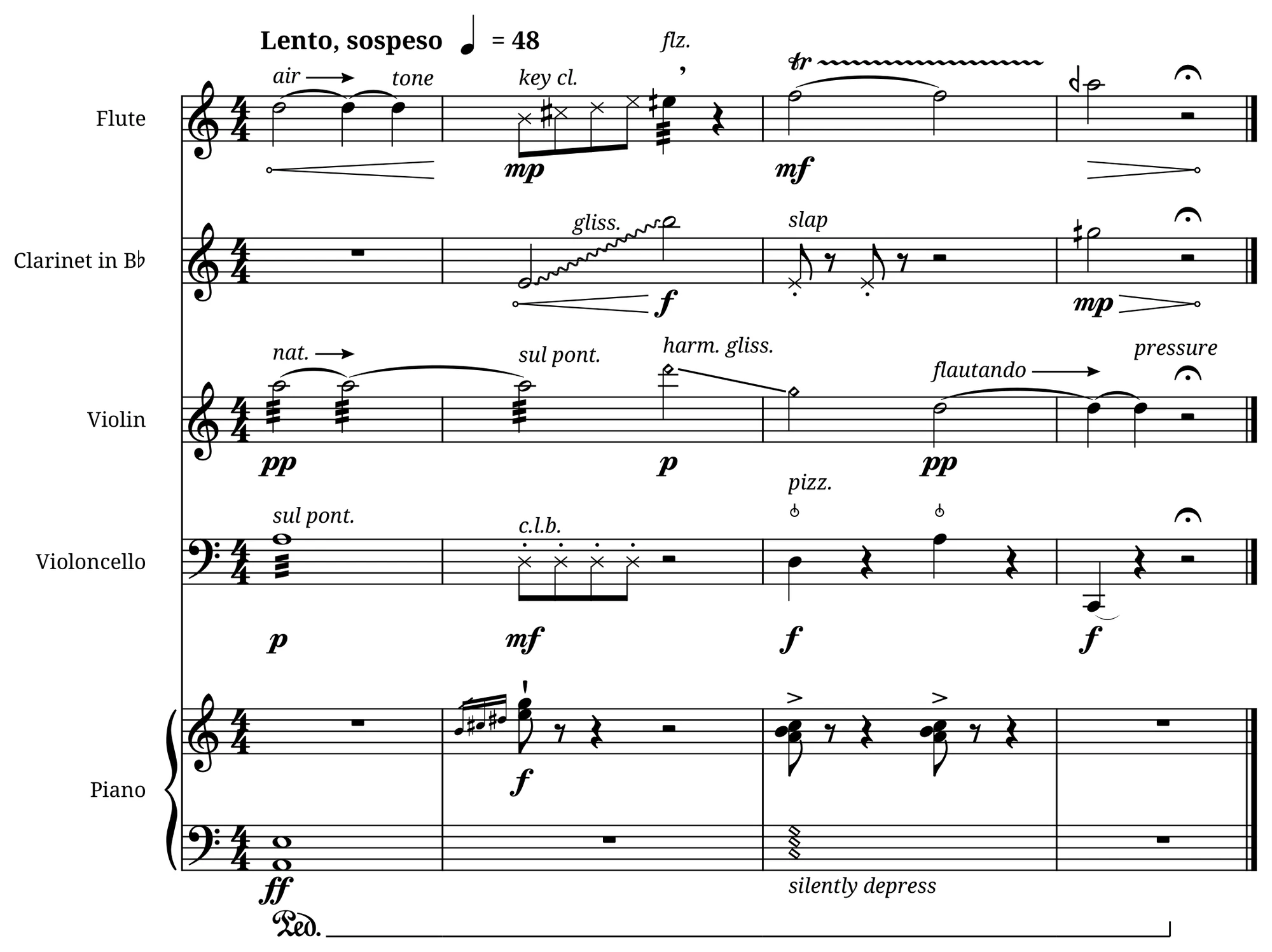
Four bars of Tidepool, for flute, clarinet, violin, cello and piano: air turning into tone, key clicks, flutter tongue, slap tongue, a wavy glissando, a harmonic glissando, col legno, snap pizzicati, quarter tones, and clusters struck over keys held down silently under the pedal.

Air that turns into tone, key clicks, slap tongue, harmonic glissandi, quarter tones, clusters over keys held down without a sound: Arietto writes the techniques of new music with the same care as a crescendo. Each one is a real sign in the score, not a picture laid on top of it.

For guitarists
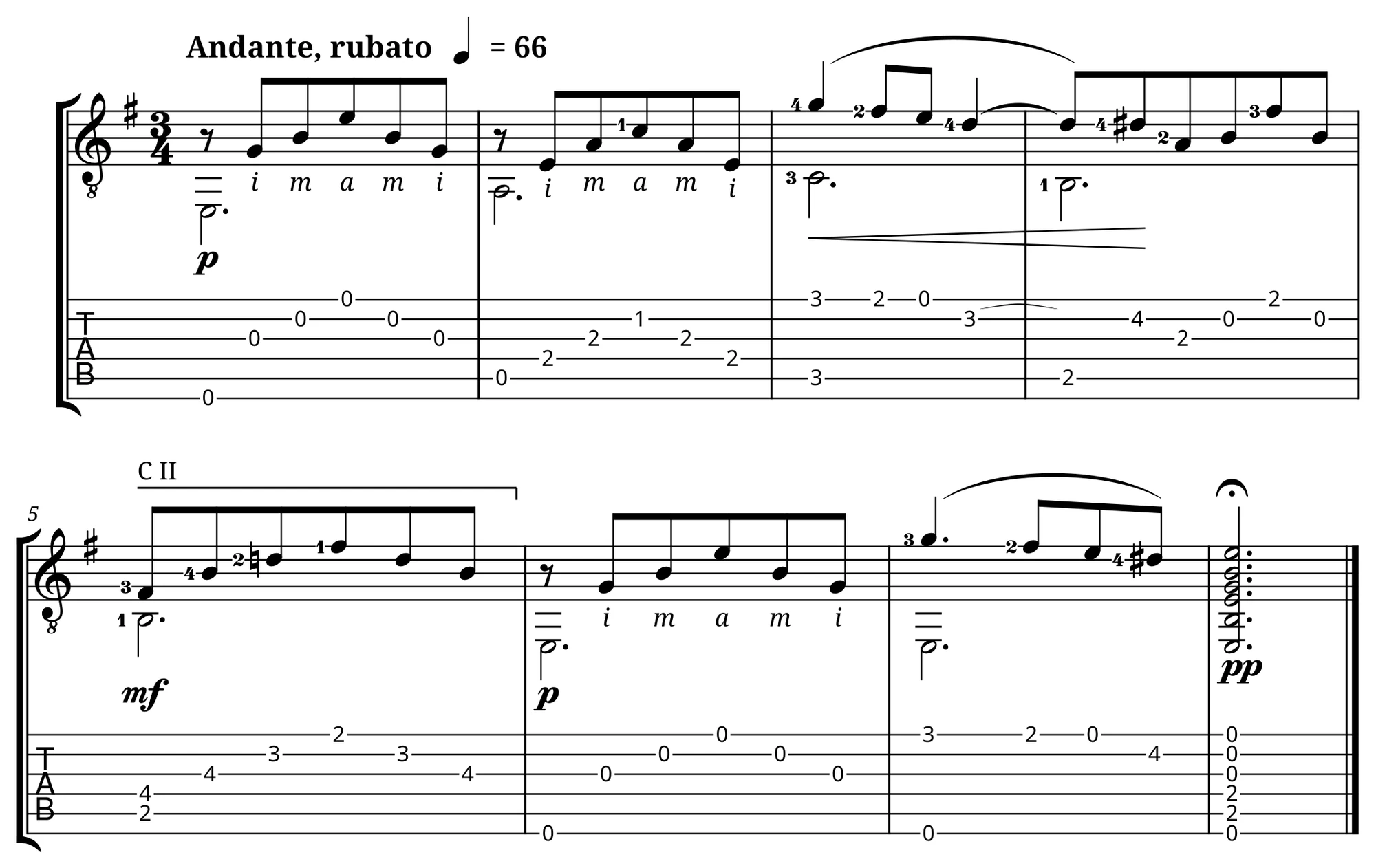
Two systems of Driftwood, a prelude for guitar, with the tablature underneath: fingerings for both hands, a barré on the second fret, slurs and a tie, and a closing chord under a fermata.

Fingerings for both hands, the barré, slurs and ties, and the tablature underneath.

The small marks
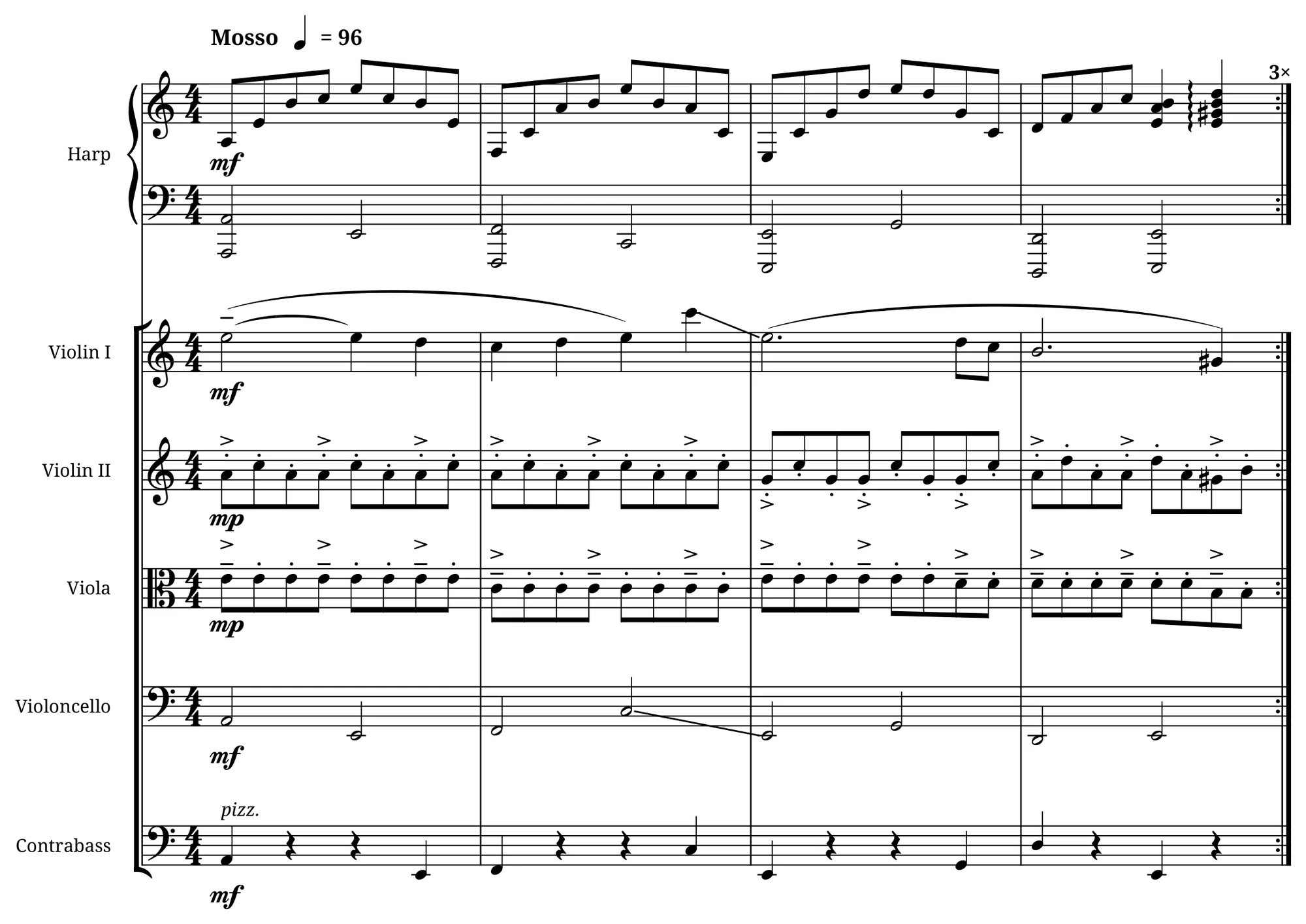
Four bars of Saltmarsh, for harp and strings, played three times, with "3×" over the closing repeat sign. The first violin's tune opens on a tied E with a tenuto, its slur starting above the tenuto; at the end of bar 2 the first violin slides down from a high C over the barline to the E, and the cello from its C to the E below. The second violins and violas drive on in eighths grouped 3 + 3 + 2, each accent with a staccato dot or a tenuto beside it at the edge of the staff, over the harp's arpeggios and the double bass's pizzicato.

Part of this week went into marks you only notice when they are wrong. A glissando that crosses a barline now also sounds right in playback, sliding all the way to its note. A staccato or a tenuto under an accent sits neatly next to it at the edge of the staff. A slur that ends on a tied note no longer runs into its tenuto. And a repeat can say "3×": double-click the barline and type the number.

Warmer colours
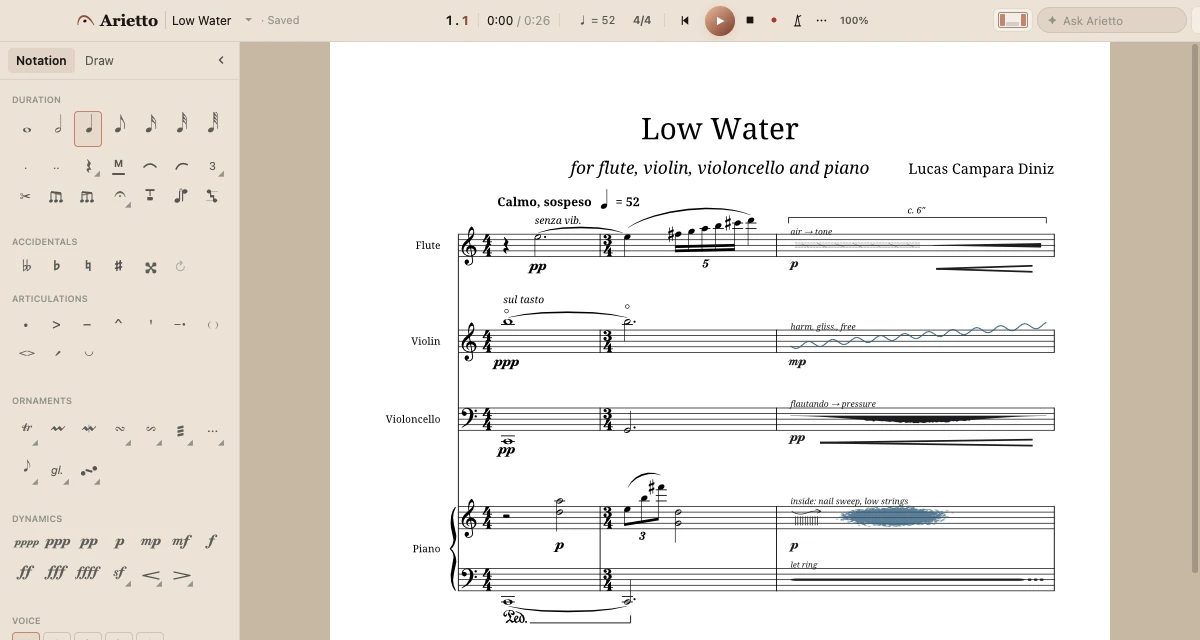
Arietto's light theme in warm linen tones: the notation palette on the left, the bar at the top and the canvas around the white first page of Low Water.

The light mode is getting warmer: linen tones around the white page instead of cool greys. Calmer around the music.

How it is going

Well. The list of what still has to be done before the closed beta is very short now.

Thank you to everyone who applied this week.

Lucas

The newsletter

One email when there is something worth reading.

What has been built, when the beta opens, and when Arietto is ready.