No. 2 ·
Customise everything, one hairpin at a time
Hairpins that tilt, grow out of nothing and take any shape; slurs drawn in the line you choose; large time signatures with room of their own. A very good week, and how it is going.

It has been a big week at the desk, and a very good one. Arietto has grown a great deal since Monday, most of all in the things a composer shapes by hand: hairpins, slurs, large time signatures, and the small marks a guitarist reads. Every picture below is engraved by Arietto without manual adjustment: what you see was chosen in its windows, and nothing was dragged into place.
Hairpins made to measure
In Arietto a hairpin can be shaped like any other part of the music: how wide it opens and closes, how thick its lines are, and whether it is solid, dashed or dotted. A hairpin can tilt, grow out of nothing or fade into nothing, open slowly or quickly, hold a dynamic inside it, and each piece of a hairpin that crosses a system break can have settings of its own.
Out of nothing, into nothing
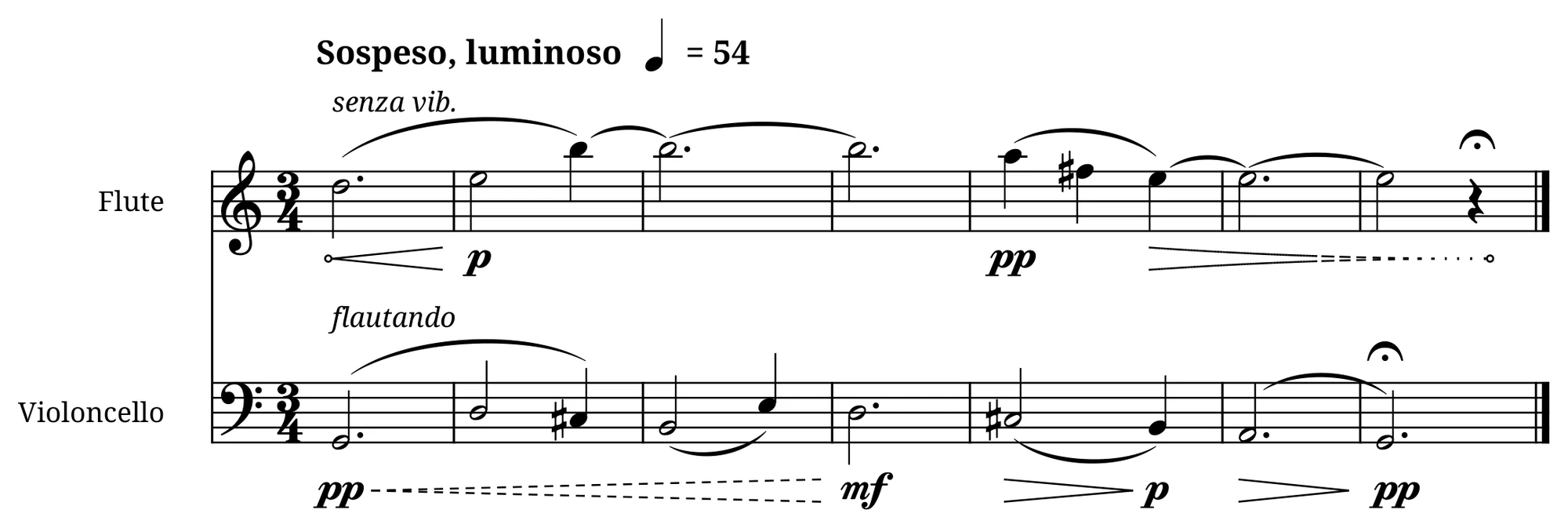
A small circle at the closed tip says niente: from nothing, or into nothing. A hairpin can also fade, its line breaking into dashes and dots towards the silent end, in four different ways, and its sides can curve as the sound swells or dies away.
Slowly, then all at once
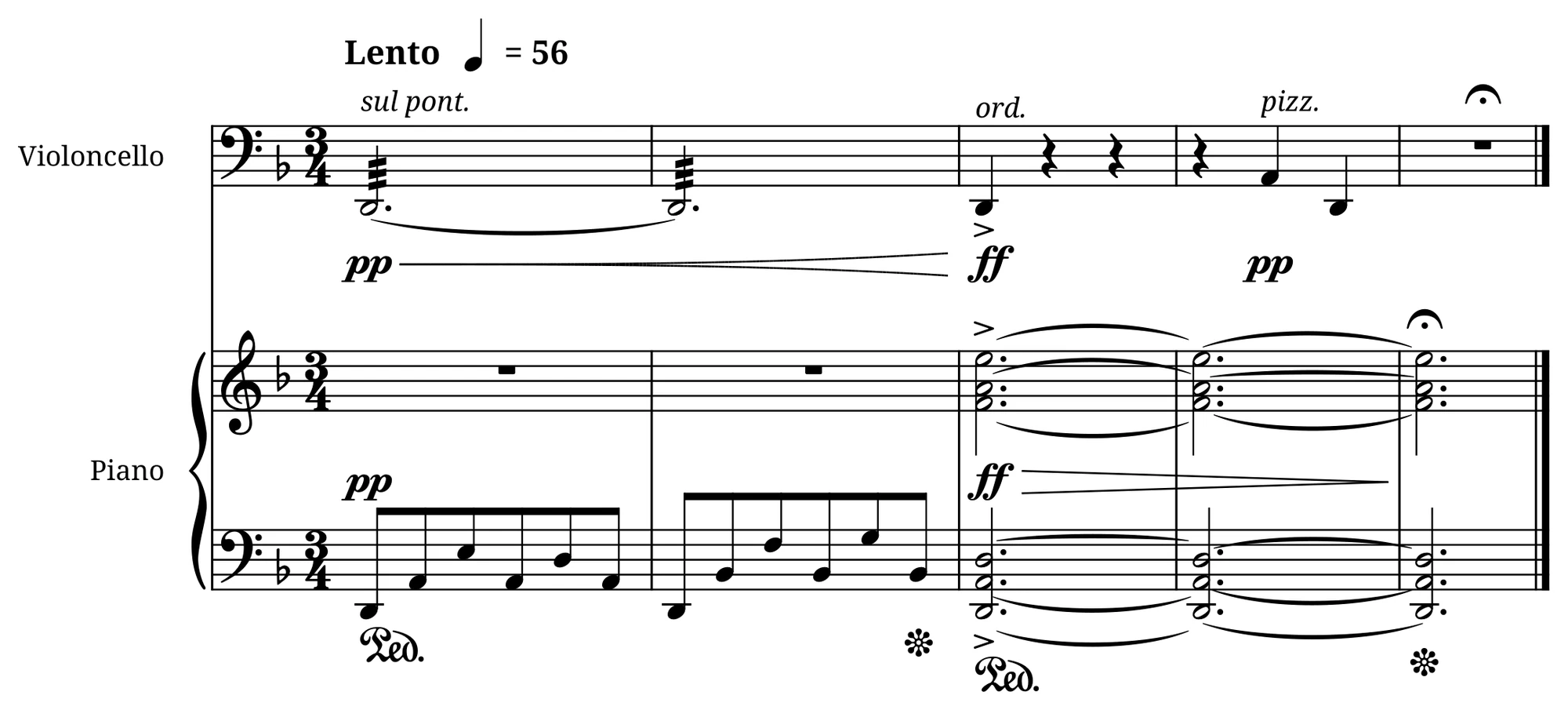
Not every crescendo grows evenly. A shaped hairpin opens slowly and then fast, or the other way round, so the page shows where the sound really grows.
When the music moves, the hairpin can follow
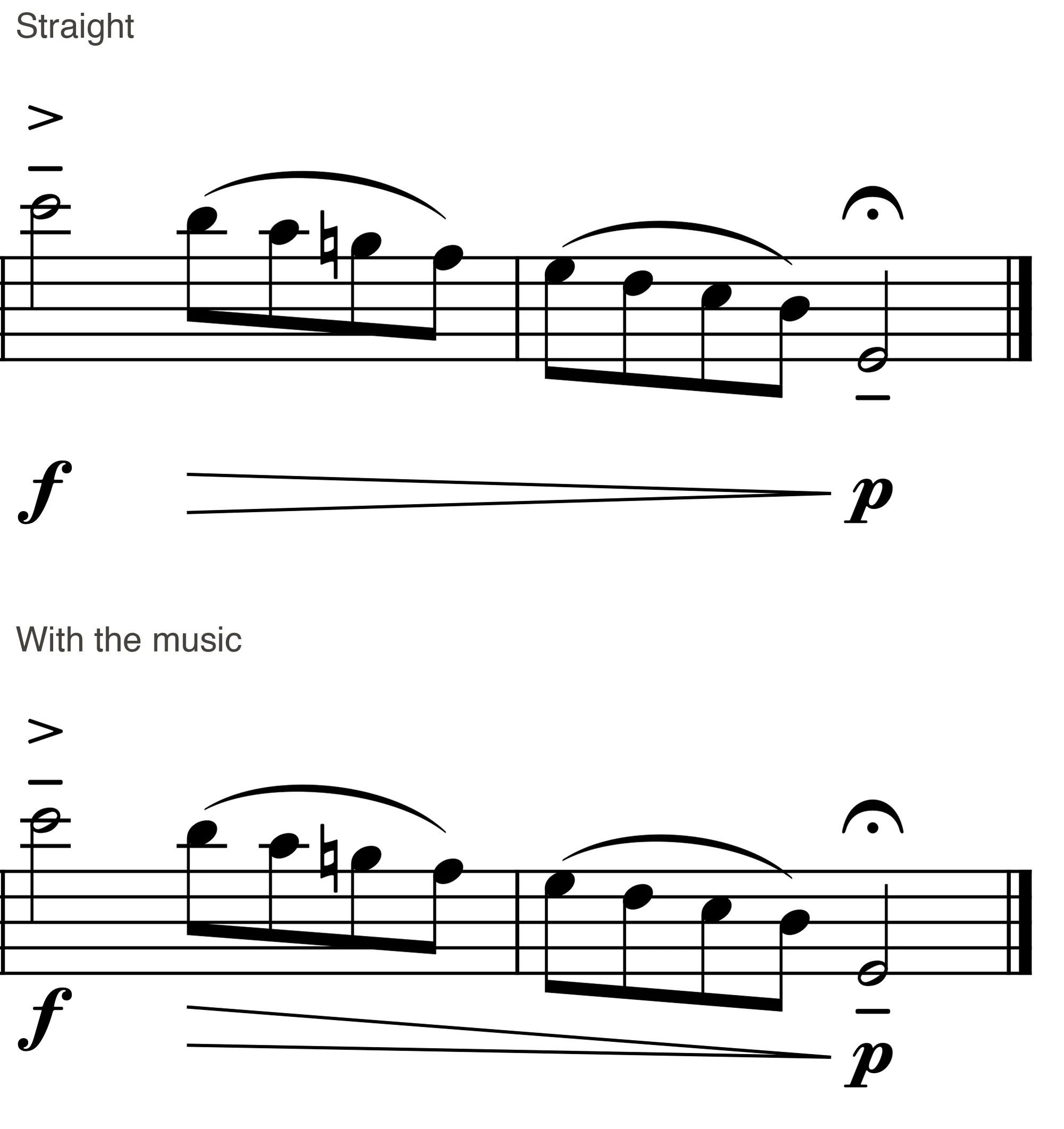
When a phrase falls from high notes into the low register, a straight hairpin has to hang as low as its lowest note, far from where the phrase began. Set to follow the music, each end of the hairpin sits at its own dynamic's height, close to its notes, and the hairpin tilts gently between them: never more than a few degrees, and never through a staff line or a note.
All in one small window
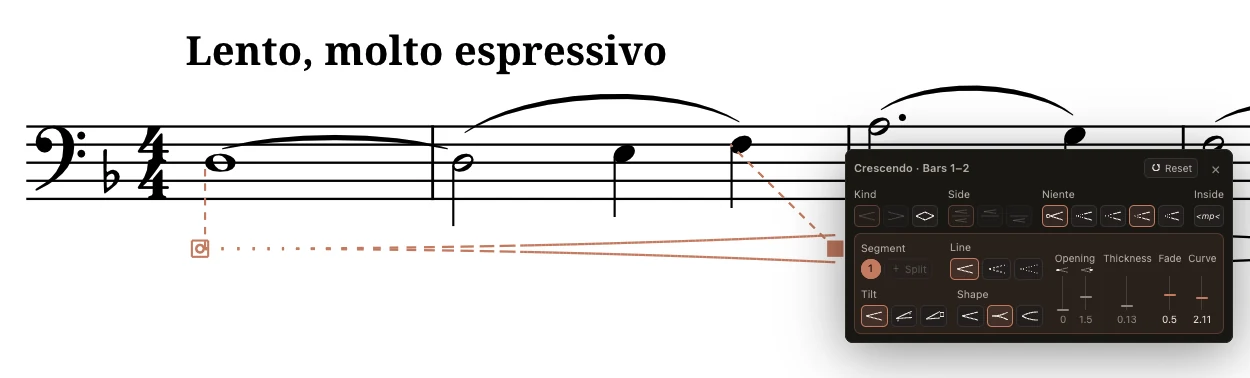
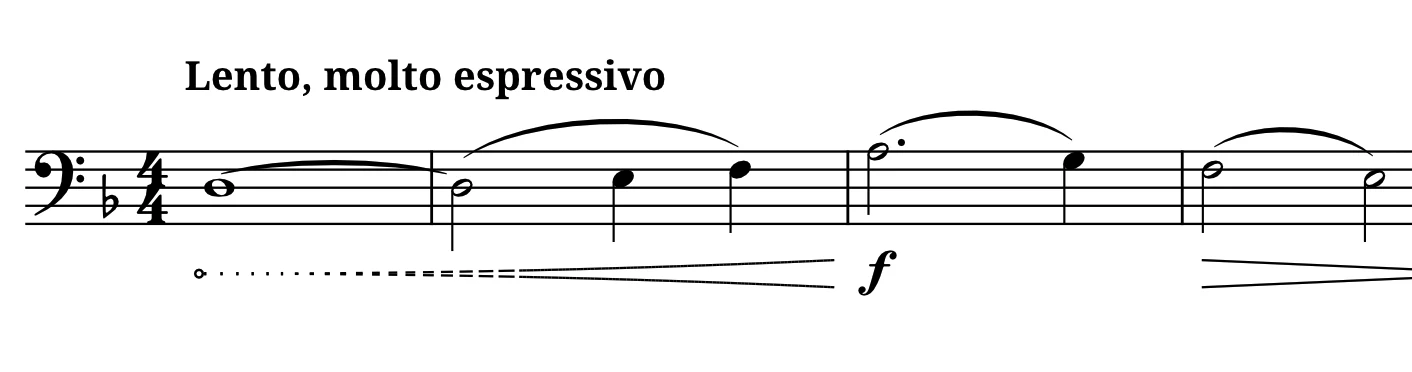
All of it is set in the hairpin's own window, right beside it. Closed, the window leaves nothing behind: the hairpin prints exactly as it was set.
Slurs in the line you choose
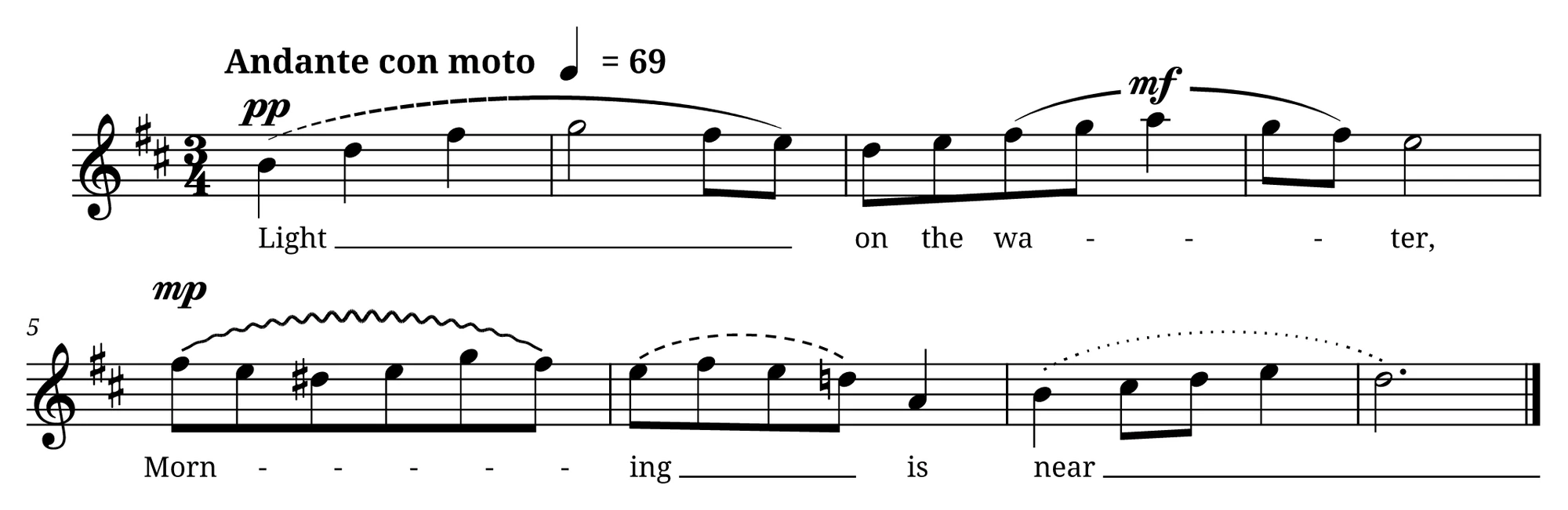
A slur has its own window too. Its line can be solid, dashed, dotted or wavy, with dashes, dots and waves of the size you set. It can be split into segments, each with its own line, so that dashes lengthen into a solid line. Where a dynamic or another mark stands in its way, the slur can keep its shape and leave a little white round the mark instead of jumping over it. It can turn into an S when the line crosses from below the notes to above them, and change sides after a system break. And for guitarists, a slur never runs through a string number: the slur keeps its shape, and the number stands outside it.
Large time signatures with room of their own
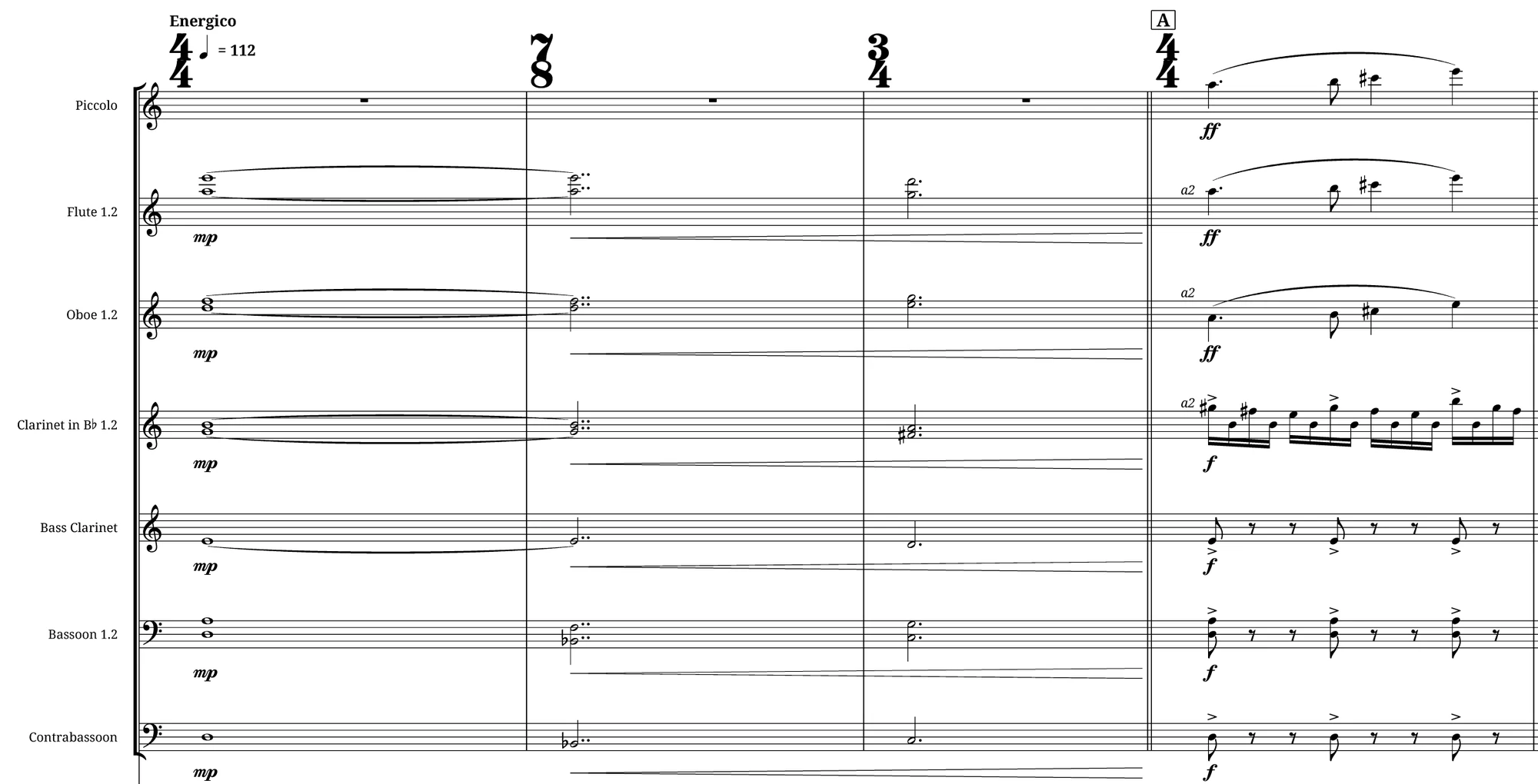
In orchestral scores whose metre changes often, the time signatures can stand large, once per group of instruments, so they can be read from the podium. They have room of their own: the music never runs into them, hairpins pass through them without stopping short, and the tempo marks stand beside them, the metronome mark to the right of the figure and the tempo words on the row of the rehearsal letters. In new orchestral scores they stand above the score and above the strings, the way many printed scores do; the other placements are a choice.
For guitarists
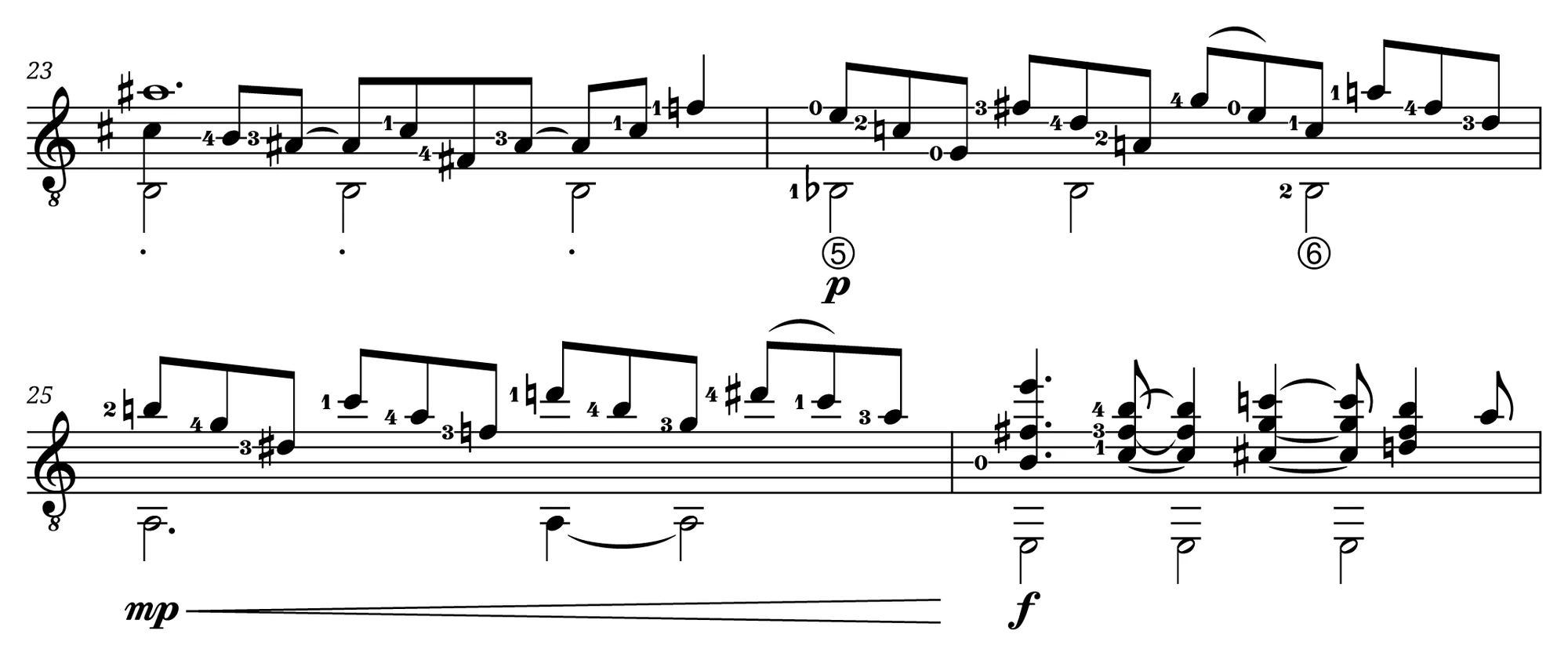
Fingerings sit where a guitarist's own engraving puts them, small and on the lines, with the staff lines running through. String numbers never stand across a stem, and they stay outside slurs and ties.
How it is going
Very well: the list of what has to be done before the closed beta gets shorter every day.
Right now the titles, headers and the title page are getting the same care: everything on a page around the music, set exactly where you want it.
And thank you to everyone who applied for the closed beta this week. There are more of you than I expected.
Lucas